Obervability
Services
AudiTrace
Resources▾
Contact
Book a free audit
From the audit · FinOps
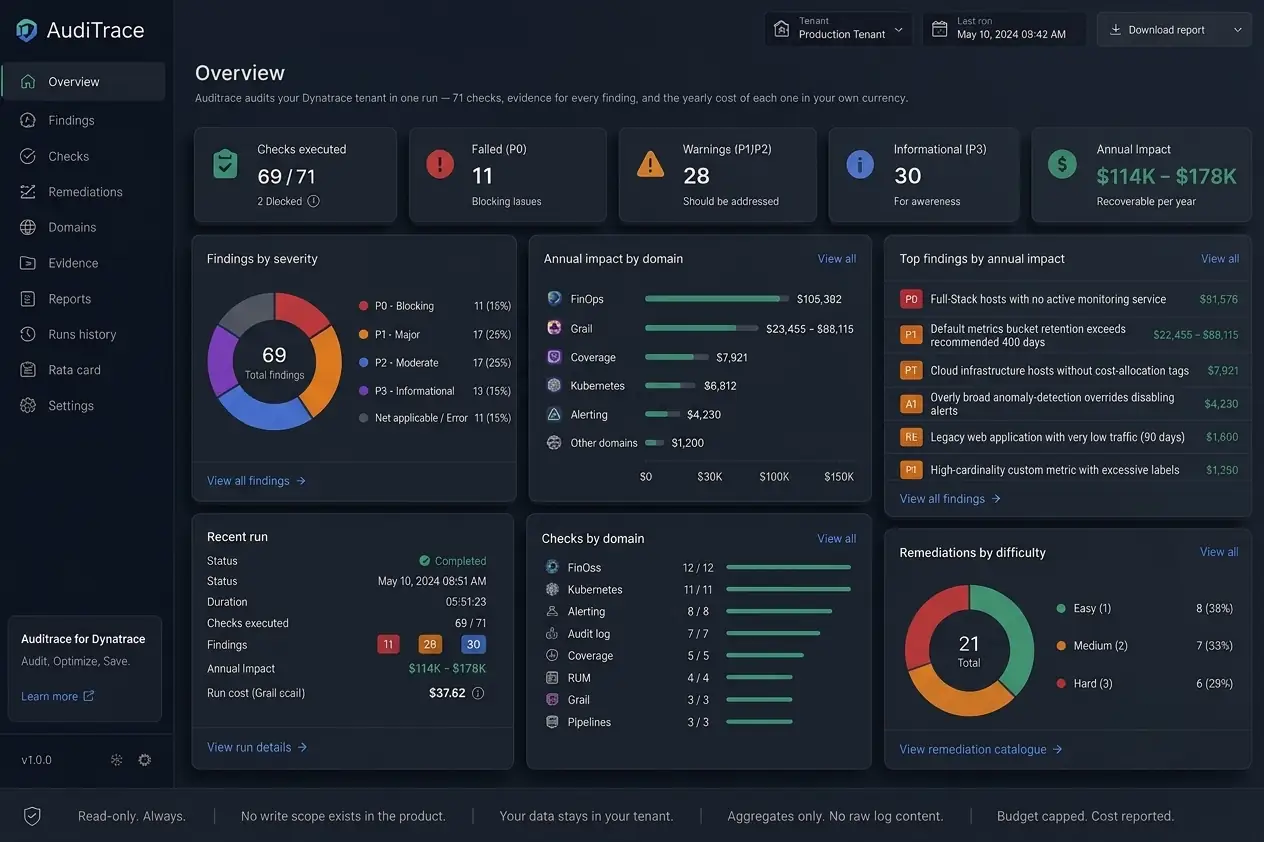
The $91,576 question: Full-Stack hosts with nothing monitored on them
140 hosts were consuming Full-Stack licence on one tenant with no monitored service behind any of them. Nobody decided that. A rollout did, and no report since was shaped to show it.
Published 16 September 2026
What the check looks for
Dynatrace prices a Full-Stack host whether or not anything useful is running on it. That is not a flaw — the agent is deployed, the host is monitored, the meter runs. It only becomes a problem when the second half of the sentence stops being true: the host is monitored, and there is nothing on it to monitor.
The check is deliberately narrow. Take every host in Full-Stack monitoring mode, join it to the process groups and services Dynatrace has detected on it, and keep the ones where that join comes back empty over the whole window. Not "low traffic". Not "quiet". Empty.
What it found
On the enterprise tenant in our case study: 140 hosts. Priced on that customer’s own negotiated rate card and annualised, $91,576 a year. It was the single largest line in the entire audit, and it was invisible on every dashboard in the tenant — because a dashboard answers "is what we monitor healthy", and these hosts were perfectly healthy. They were just not monitoring anything.
The distribution was the interesting part. They were not scattered randomly: they clustered in two subnets that had been migrated eighteen months earlier, where the OneAgent rollout had been part of the base image and the workloads that were supposed to follow never did.
Why nobody noticed
Three things have to go wrong together, and all three are normal. The agent deploys automatically, so nobody chooses per host. Consumption is reported in aggregate, so 140 hosts out of several thousand never surface as a line. And no alert exists for "this host is monitored and idle", because from the platform’s point of view nothing is wrong.
The result is a cost that behaves like a fixed cost. It arrives every year, it is never questioned, and the only way to find it is to go looking with a query that nobody has a reason to write.
The shape of the query
Roughly what the check does, in DQL — the logic behind the finding, so it is clear what it rests on:
DQL
fetch dt.entity.host
| filter monitoringMode == "FULL_STACK"
| fieldsAdd services = entityAttr(id, "runs")
| filter isNull(services) or arraySize(services) == 0
| fields id, entity.name, osType
What to do with the answer
Not all 140 are waste, and the report does not claim they are. Some machines genuinely run nothing between batch windows, and monitoring them in Full-Stack mode is a deliberate choice somebody should be able to point at. The finding exists so that the choice becomes explicit: here are the hosts, here is what they cost, tell us which ones are intentional.
For the rest the remediation is a monitoring-mode change rather than an uninstall — infrastructure mode keeps the host visible and stops the Full-Stack meter. It is reversible, it takes minutes, and on this tenant it was worth more than every other finding in the audit combined.
The finding behind this piece
Full-Stack hosts with no monitored service
Scale
140 hosts
Impact
$91,576 / year
The takeaway
A licence line with no workload behind it is not a monitoring problem, and nothing in the product will raise it as one. It is only ever found by asking.
More from the series
The Grail bucket nobody chose: 462 days of retention
From the audit · Grail
1,617 maintenance windows: how alerting goes quiet without anyone deciding
From the audit · Alerting
Personal data in logs: 50 sources, about 30.7 million records a day
From the audit · Pipelines
What actually lands on a DPS invoice
From the audit · FinOps
Find out what your own tenant says.
One read-only run, 71 checks, and the source behind every finding. You keep the report either way.
Book a free audit
AudiTrace
Find out what your Obervability is actually doing.
An audit takes one run. The findings take one meeting. What you do with them is up to you.
Certified Dynatrace experts
+1
Obervability
Dynatrace implementation, managed services and support. Every finding comes with the source behind it.
Services
Services
AudiTrace
Case study
Guides
Dynatrace audit
Dynatrace cost optimization
Audit case study
Articles
Reach us
Contact
hello@obzervability.com
© 2026 Obervability · All rights reserved.
Privacy
Terms of use
Accessibility
Obervability
{{ t.navServices }}
AudiTrace
{{ resLabel }}▾
{{ t.navContact }}
{{ footGuideAudit }}
{{ footGuideCost }}
{{ footGuideCase }}
{{ footGuideArticles }}
{{ langLabel }} ▾
English
{{ altLabel }}
{{ t.heroKicker }}
{{ t.heroTitle }}
{{ t.heroSub }}
{{ t.heroCta1 }}
{{ t.heroCta2 }}
{{ t.badge }}
71
{{ t.stripChecks }}
19
{{ t.stripDomains }}
21
{{ t.stripRem }}
0
{{ t.stripWrite }}
{{ t.svcTitle }}
{{ t.s1t }}
{{ t.s1d }}
{{ t.s2t }}
{{ t.s2d }}
{{ t.s3t }}
{{ t.s3d }}
{{ t.caseKicker }}
{{ t.caseTitle }}
{{ t.caseCtx }}
{{ t.caseNote }}
{{ t.svcKick }}
{{ t.svcTitle2 }}
{{ t.svcSub }}
{{ t.heroCta1 }}
{{ t.svcCta2 }}
71
{{ t.svcL1 }}
$114–178k
{{ t.svcL2 }}
0
{{ t.svcL3 }}
{{ t.svcTracksT }}
{{ t.svcTracksD }}
{{ k.t }}
{{ k.g }}
{{ k.d }}
{{ t.fcTitle }}
{{ t.svcFindD }}
{{ f.t }}
{{ f.d }}
{{ t.svcEngT }}
{{ t.colEng }}
{{ t.colTrack }}
{{ t.colShape }}
{{ e.n }}
{{ e.k }}
{{ e.s }}
{{ t.svcCtaT }}
{{ t.svcCtaD }}
{{ g.kicker }}
{{ g.title }}
{{ g.sub }}
{{ g.cta1 }}
{{ g.cta2 }}
{{ g.s1h }}
{{ p.t }}
{{ g.s2h }}
{{ g.s2sub }}
{{ c.t }}
{{ c.d }}
{{ g.s3h }}
{{ g.s3sub }}
{{ g.s4h }}
{{ g.s4sub }}
{{ g.tableNote }}
{{ g.s5h }}
{{ g.s5sub }}
{{ k.t }}
{{ k.d }}
{{ g.s6h }}
{{ c.t }}
{{ c.d }}
{{ g.faqH }}
{{ f.q }}
{{ f.a }}
{{ g.closerT }}
{{ g.closerD }}
{{ g.cta1 }}
{{ g.closerCta }}
{{ g.kicker }}
{{ g.title }}
{{ g.sub }}
{{ g.cta1 }}
{{ g.cta2 }}
{{ g.s1h }}
{{ p.t }}
{{ g.s2h }}
{{ g.s2sub }}
{{ g.tableNote }}
{{ g.s3h }}
{{ c.t }}
{{ c.d }}
{{ g.s4h }}
{{ c.t }}
{{ c.d }}
{{ g.faqH }}
{{ f.q }}
{{ f.a }}
{{ g.closerT }}
{{ g.closerD }}
{{ g.cta1 }}
{{ g.closerCta }}
{{ dom.kicker }}
{{ dom.title }}
{{ dom.lede }}
{{ dom.ctaBook }}
{{ dom.ctaChecks }}
{{ dom.hReads }}
{{ r.t }}
{{ r.d }}
{{ dom.hWhy }}
{{ p.t }}
{{ dom.findLabel }}
{{ dom.findName }}
{{ dom.lblScale }}
{{ dom.findScale }}
{{ dom.lblImpact }}
{{ dom.findImpact }}
{{ dom.findNote }}
{{ dom.hFaqs }}
{{ f.q }}
{{ f.a }}
{{ dom.hOther }}
{{ dom.otherSub }}
{{ dom.closerT }}
{{ dom.closerD }}
{{ dom.ctaBook }}
{{ dom.closerCta }}
{{ c.kicker }}
{{ c.title }}
{{ c.sub }}
{{ c.cta1 }}
{{ c.cta2 }}
{{ f.n }}
{{ f.l }}
{{ c.s1h }}
{{ c.s1sub }}
{{ c.tableNote }}
{{ c.s2h }}
{{ p.t }}
{{ c.s3h }}
{{ a.t }}
{{ a.d }}
{{ c.s4h }}
{{ f.q }}
{{ f.a }}
{{ c.closerT }}
{{ c.closerD }}
{{ c.cta1 }}
{{ c.closerCta }}
{{ art.kicker }}
{{ art.title }}
{{ art.dek }}
{{ art.dateLine }}
{{ s.h }}
{{ p.t }}
DQL
{{ s.code }}
{{ art.findLabel }}
{{ art.findName }}
{{ art.scaleLabel }}
{{ art.findScale }}
{{ art.impactLabel }}
{{ art.findImpact }}
{{ art.takeawayLabel }}
{{ art.takeaway }}
{{ art.moreLabel }}
{{ art.ctaTitle }}
{{ art.ctaSub }}
{{ art.ctaBtn }}
AudiTrace
{{ artIndexKicker }}
{{ artIndexTitle }}
{{ artIndexSub }}
{{ t.privTitle }}
{{ t.privUpdated }}
{{ s.h }}
{{ s.b }}
{{ t.termsTitle }}
{{ t.termsUpdated }}
{{ s.h }}
{{ s.b }}
{{ t.a11yTitle }}
{{ t.a11yUpdated }}
{{ s.h }}
{{ s.b }}
{{ c.t }}
{{ c.d }}
{{ t.pTitle }}
{{ p.t }}
{{ p.d }}
{{ p.fig }}
{{ t.hTitle }}
{{ s.n }}
{{ s.t }}
{{ s.d }}
{{ t.way1k }}
{{ t.way1t }}
{{ t.way1d }}
{{ t.way2k }}
{{ t.way2t }}
{{ t.way2d }}
{{ t.waysNote }}
{{ t.fcTitle }}
{{ i.t }}
{{ i.d }}
{{ t.prDelTitle }}
{{ d.t }}
{{ d.d }}
{{ t.dTitle }}
{{ t.dSub }}
{{ t.secTitle }}
{{ b.t }}
{{ b.d }}
{{ n.t }}
{{ t.oTitle }}
{{ o.k }}
{{ o.t }}
{{ o.d }}
{{ o.p }}
{{ t.faqTitle }}
{{ q.q }}
{{ q.a }}
{{ t.cTitle }}
{{ t.cSub }}
{{ t.badge }}
{{ t.fSentT }}
{{ t.fSentD }}
{{ ccDial }}
{{ formErrMsg }}
{{ t.footColServices }}
{{ t.navServices }}
AudiTrace
{{ t.navCase }}
{{ t.footColGuides }}
{{ footGuideAudit }}
{{ footGuideCost }}
{{ footGuideCase }}
{{ footGuideArticles }}
{{ t.footColReach }}
{{ t.navContact }}
hello@obzervability.com
© 2026 Obzervability · {{ t.footRights }}
{{ t.navPrivacy }}
{{ t.navTerms }}
{{ t.navA11y }}