Obervability
Services
AudiTrace
Resources▾
Contact
Book a free audit
Dynatrace cost optimization
Dynatrace cost optimization with AudiTrace, matched to your contract rates.
Not list price, and not a percentage promised before anyone has looked. We find where consumption is going, value each finding at the rate you actually pay, and hand you the source behind every number.
Book a free audit
See what an audit covers
Where Dynatrace spend actually goes
Almost every surprise on a Dynatrace invoice comes from one of four places: how many hosts are running in which monitoring mode, how much data is ingested, how long that data is kept, and how much of it is queried. Everything else is rounding.
None of those four is visible from the place people look. The host list shows you hosts, not what each one is costing as a consequence of its mode. The bucket list shows you buckets, not the annualized price of the retention sitting on them. So the conversation about cost usually happens with the invoice on one side of the table and nothing comparable on the other.
An audit closes that gap by pricing the objects rather than the invoice: this many hosts in this mode, this bucket at this retention, these applications with no traffic — each one valued on the rate card you negotiated, each one with the source that produced the count.
The four places the money usually is
These are real rows from one customer, a very large shipping company, not a worked example. They are the four findings from that engagement that carried a price.
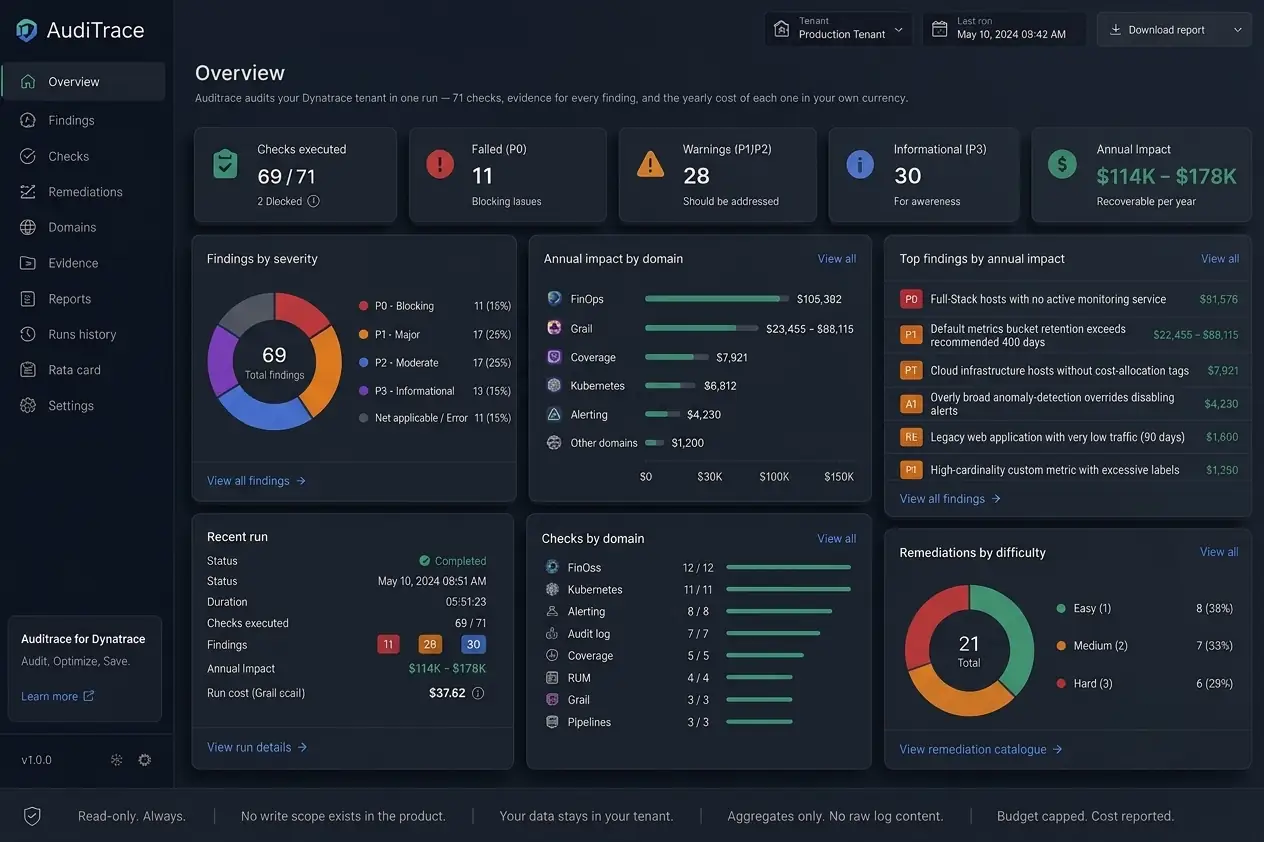
The retention range reflects a decision that belonged to the client, not an uncertainty in the measurement. Across all 71 checks that tenant came to $114,000–178,000 per year.
How a finding gets priced
Your rate card, not list price
List price makes a report look better and makes it useless in a negotiation. We price on the rates you actually pay, which means you have to give them to us — and if you do not, the report says so instead of guessing.
A cost is never added to a saving
If removing a finding creates consumption somewhere else, that appears as a deduction in the same row. A number that only counts one direction is a sales figure, not an estimate.
A range where the decision is yours
Retention is the clearest case: what it should be is a policy question, so the report gives the cost at each end of the reasonable band rather than picking one for you.
Every number has a source under it
The count, the objects, and the arithmetic are all in the report, and every row carries the source it came from. Another AudiTrace run returns the same number, which is the only reason to trust any of it.
What we will not do
Cut coverage to cut the bill
Turning off monitoring is the fastest saving available and the worst one. A saving that blinds you is a cost with a delay on it. Findings that reduce coverage are marked as such and priced against what they would hide.
Change anything ourselves
The audit is read-only. Remediation is catalogued, sequenced and handed over; when and whether to apply it is a change your team schedules, not something that happens while a report runs.
Quote a percentage first
Anyone promising "30% off your observability spend" before looking at your tenant is quoting an average, and your tenant is not an average. The number comes after the run.
Questions we get asked first
Can you guarantee a saving?
No, and nobody can, straight off, before they have looked. What is guaranteed is that every number in the report arrives with the source behind it, so you can check it rather than believe it.
Do you need our contract rates?
For money, yes. Without them the report still gives you every quantity — hosts, buckets, retention days, applications — but it reports them as quantities rather than resting on the vendor’s public list price.
Does this depend on which licensing model we are on?
The audit reads what your tenant reports about its own consumption. Which of those units carry cost depends on the model you are on, and only the ones that do get priced.
Is cost optimization a one-off or ongoing?
Both work. A single audit finds what has accumulated; the managed-service retainer keeps it from accumulating again, with a monthly report of what changed and what it cost.
What if the savings are in a decision we do not want to make?
Then it stays a finding and does not become a recommendation. Retention is the usual case: the report prices the options and leaves the choice where it belongs. AudiTrace performs no write operations in any case, and changes nothing in your system.
Want to find out what yours is actually costing?
One read-only run, priced on your own rates. You keep the report whatever you decide to do with it.
Book a free audit
See how AudiTrace works
Find out what your Obervability is actually doing.
An audit takes one run. The findings take one meeting. What you do with them is up to you.
Certified Dynatrace experts
+1
Obervability
Dynatrace implementation, managed services and support. Every finding comes with the source behind it.
Services
Services
AudiTrace
Case study
Guides
Dynatrace audit
Dynatrace cost optimization
Audit case study
Articles
Reach us
Contact
hello@obzervability.com
© 2026 Obervability · All rights reserved.
Privacy
Terms of use
Accessibility
Obervability
{{ t.navServices }}
AudiTrace
{{ resLabel }}▾
{{ t.navContact }}
{{ footGuideAudit }}
{{ footGuideCost }}
{{ footGuideCase }}
{{ footGuideArticles }}
{{ langLabel }} ▾
English
{{ altLabel }}
{{ t.heroKicker }}
{{ t.heroTitle }}
{{ t.heroSub }}
{{ t.heroCta1 }}
{{ t.heroCta2 }}
{{ t.badge }}
71
{{ t.stripChecks }}
19
{{ t.stripDomains }}
21
{{ t.stripRem }}
0
{{ t.stripWrite }}
{{ t.svcTitle }}
{{ t.s1t }}
{{ t.s1d }}
{{ t.s2t }}
{{ t.s2d }}
{{ t.s3t }}
{{ t.s3d }}
{{ t.caseKicker }}
{{ t.caseTitle }}
{{ t.caseCtx }}
{{ t.caseNote }}
{{ t.svcKick }}
{{ t.svcTitle2 }}
{{ t.svcSub }}
{{ t.heroCta1 }}
{{ t.svcCta2 }}
71
{{ t.svcL1 }}
$114–178k
{{ t.svcL2 }}
0
{{ t.svcL3 }}
{{ t.svcTracksT }}
{{ t.svcTracksD }}
{{ k.t }}
{{ k.g }}
{{ k.d }}
{{ t.fcTitle }}
{{ t.svcFindD }}
{{ f.t }}
{{ f.d }}
{{ t.svcEngT }}
{{ t.colEng }}
{{ t.colTrack }}
{{ t.colShape }}
{{ e.n }}
{{ e.k }}
{{ e.s }}
{{ t.svcCtaT }}
{{ t.svcCtaD }}
{{ g.kicker }}
{{ g.title }}
{{ g.sub }}
{{ g.cta1 }}
{{ g.cta2 }}
{{ g.s1h }}
{{ p.t }}
{{ g.s2h }}
{{ g.s2sub }}
{{ c.t }}
{{ c.d }}
{{ g.s3h }}
{{ g.s3sub }}
{{ g.s4h }}
{{ g.s4sub }}
{{ g.tableNote }}
{{ g.s5h }}
{{ g.s5sub }}
{{ k.t }}
{{ k.d }}
{{ g.s6h }}
{{ c.t }}
{{ c.d }}
{{ g.faqH }}
{{ f.q }}
{{ f.a }}
{{ g.closerT }}
{{ g.closerD }}
{{ g.cta1 }}
{{ g.closerCta }}
{{ g.kicker }}
{{ g.title }}
{{ g.sub }}
{{ g.cta1 }}
{{ g.cta2 }}
{{ g.s1h }}
{{ p.t }}
{{ g.s2h }}
{{ g.s2sub }}
{{ g.tableNote }}
{{ g.s3h }}
{{ c.t }}
{{ c.d }}
{{ g.s4h }}
{{ c.t }}
{{ c.d }}
{{ g.faqH }}
{{ f.q }}
{{ f.a }}
{{ g.closerT }}
{{ g.closerD }}
{{ g.cta1 }}
{{ g.closerCta }}
{{ dom.kicker }}
{{ dom.title }}
{{ dom.lede }}
{{ dom.ctaBook }}
{{ dom.ctaChecks }}
{{ dom.hReads }}
{{ r.t }}
{{ r.d }}
{{ dom.hWhy }}
{{ p.t }}
{{ dom.findLabel }}
{{ dom.findName }}
{{ dom.lblScale }}
{{ dom.findScale }}
{{ dom.lblImpact }}
{{ dom.findImpact }}
{{ dom.findNote }}
{{ dom.hFaqs }}
{{ f.q }}
{{ f.a }}
{{ dom.hOther }}
{{ dom.otherSub }}
{{ dom.closerT }}
{{ dom.closerD }}
{{ dom.ctaBook }}
{{ dom.closerCta }}
{{ c.kicker }}
{{ c.title }}
{{ c.sub }}
{{ c.cta1 }}
{{ c.cta2 }}
{{ f.n }}
{{ f.l }}
{{ c.s1h }}
{{ c.s1sub }}
{{ c.tableNote }}
{{ c.s2h }}
{{ p.t }}
{{ c.s3h }}
{{ a.t }}
{{ a.d }}
{{ c.s4h }}
{{ f.q }}
{{ f.a }}
{{ c.closerT }}
{{ c.closerD }}
{{ c.cta1 }}
{{ c.closerCta }}
{{ art.kicker }}
{{ art.title }}
{{ art.dek }}
{{ art.dateLine }}
{{ s.h }}
{{ p.t }}
DQL
{{ s.code }}
{{ art.findLabel }}
{{ art.findName }}
{{ art.scaleLabel }}
{{ art.findScale }}
{{ art.impactLabel }}
{{ art.findImpact }}
{{ art.takeawayLabel }}
{{ art.takeaway }}
{{ art.moreLabel }}
{{ art.ctaTitle }}
{{ art.ctaSub }}
{{ art.ctaBtn }}
AudiTrace
{{ artIndexKicker }}
{{ artIndexTitle }}
{{ artIndexSub }}
{{ t.privTitle }}
{{ t.privUpdated }}
{{ s.h }}
{{ s.b }}
{{ t.termsTitle }}
{{ t.termsUpdated }}
{{ s.h }}
{{ s.b }}
{{ t.a11yTitle }}
{{ t.a11yUpdated }}
{{ s.h }}
{{ s.b }}
{{ c.t }}
{{ c.d }}
{{ t.pTitle }}
{{ p.t }}
{{ p.d }}
{{ p.fig }}
{{ t.hTitle }}
{{ s.n }}
{{ s.t }}
{{ s.d }}
{{ t.way1k }}
{{ t.way1t }}
{{ t.way1d }}
{{ t.way2k }}
{{ t.way2t }}
{{ t.way2d }}
{{ t.waysNote }}
{{ t.fcTitle }}
{{ i.t }}
{{ i.d }}
{{ t.prDelTitle }}
{{ d.t }}
{{ d.d }}
{{ t.dTitle }}
{{ t.dSub }}
{{ t.secTitle }}
{{ b.t }}
{{ b.d }}
{{ n.t }}
{{ t.oTitle }}
{{ o.k }}
{{ o.t }}
{{ o.d }}
{{ o.p }}
{{ t.faqTitle }}
{{ q.q }}
{{ q.a }}
{{ t.cTitle }}
{{ t.cSub }}
{{ t.badge }}
{{ t.fSentT }}
{{ t.fSentD }}
{{ ccDial }}
{{ formErrMsg }}
{{ t.footColServices }}
{{ t.navServices }}
AudiTrace
{{ t.navCase }}
{{ t.footColGuides }}
{{ footGuideAudit }}
{{ footGuideCost }}
{{ footGuideCase }}
{{ footGuideArticles }}
{{ t.footColReach }}
{{ t.navContact }}
hello@obzervability.com
© 2026 Obzervability · {{ t.footRights }}
{{ t.navPrivacy }}
{{ t.navTerms }}
{{ t.navA11y }}